Life in the Drawing Office
I joined the drawing office of Keith Blackman Ltd in 1960 having just left school with a GCE in technical drawing. Aged 16 I had spent a year longer at school than most of my friends who were already able to buy motor cycles.
My first day in the office was a rude awakening as to my inadequacy as a draughtsman. My first task was to trace off an old drawing and add a couple of modifications. My drawing was poor to say the least and the standard of my printing was no where near good enough for my boss. For the next week or so my time was spent ruling parallel lines down the page exactly 1/8 inch apart and printing the alphabet until I was sick of it, fortunately the boss was satisfied with my final efforts and I was finally allowed to begin learning the art of DRAUGHTSMANSHIP.
There were lessons in pencil sharpening for a start. A chisel point stays sharper for longer that a normal point provided one learnt how to use it correctly.
Office protocol dictated that one addressed all seniors as sir or Mr. whilst us juniors were called by surname only. All draughtsmen wore a white lab coat which usually had ink marks on the upper part of the cuffs where clogged pens were conveniently wiped. I was soon introduced to the lunchtime game of twopenny-hapenny football. The goal post were pins set each end of a table, a halfpenny piece was the ball and two penny coins were the players. One could strike either of the pennies by using a hair comb (an essential piece of equipment in 1960). There was a fiercely contested league for singles and doubles players.
The tools of my trade, initially, were a 45 degree set square, a 60/30 set square, 1 compass (pencil) large, 1 small, the same with draughting nibs for ink work. 1draughting pen a scale rule and a slide rule. I also had a book of logarithmic tables. Pencils and rubbers were provided by the company. My tool kit grew as I purchased new instruments through the draughtsman's union at a discounted price. From my first weeks wage of £4. 3s. 4d. I bought an alarm clock to ensure that I was never late for work. It cost 30 shillings and had the loudest tick imaginable.
I was issued with a pen holder and a couple of nibs which I was encouraged to file down to a profile which would suit my style of printing. I soon realised the disadvantage of my being left handed. I had had trouble at school with scratchy pen nibs and poor quality paper as the pen would dig itself in causing horrendous splashes over the page.
Left handed draughtsmen were simply not catered for. Tee squares, adjustable squares and later, draughting machines were all designed for right had use.
One day I was complaining about this to Old Frank (one of the finest draughtsmen I have ever met), who then told me of life in the office when he was a lad. Some years later I came across a booklet of drawing office practice from the turn of the century.
A stove was provided for warmth but employees were required to supply their own bucket of coal. Quills for pens were provided but should only be trimmed in ones own time (outside of office hours) however, as pencils rapidly lost their edge they could be sharpened in the firms time!
It would seem that from the time of Leonardo Da Vinci to the early twentieth century drawing equipment had changed very little.
In 1960 much of the work was done on tracing paper although for standard parts drawings which would be used frequently and thus needed to be more durable were done in ink on waxed linen. Blue prints were being phased out in favour of dyeline printing at this time. On the subject of durability, I had spent many days on one drawing on an A0 sized sheet of tracing paper only to have it returned from the print room in shreds as it had got jammed in the print machine. This was not an uncommon occurrence.
Another drawback with tracing paper was its instability due to variance in temperature and humidity. One would often arrive in the morning to find that, due to an overnight change in humidity, the paper had stretched and was sagging off the bottom of the drawing board. It could take most of the morning for it to shrink back to a condition where one could continue working on it satisfactorily. This was especially frustrating where accurate measurement was essential.
I remember one lunchtime, a colleague opened a can of cola which some prankster had shaken up. The resultant spray showered his weeks work which instantly shrivelled to the size of a postage stamp!
Similarly drawings could shrink under heat tearing it away from the drawing pins, thus the development of draughting tape. The introduction of tape also meant that there were no longer annoying little holes in the board which could cause the pencil to catch producing wavy lines and jumps. Boards were now faced with a smooth plasticised coating.
The next advancement was to plastic drawing film which was not only much more stable but was virtually indestructible. Tee squares were now replaced by parallel motion rules.
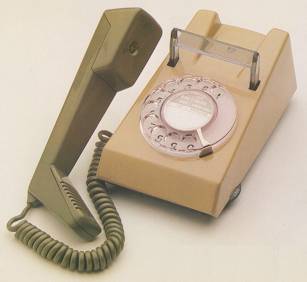
In 1965 I moved to Standard telephones & Cables spending most of my time working on the “Trimphone” pictured here (at the time it was known as the deltaphone due to its wedge shape). This had been designed by Lord Snowdon’s studios and it was my job to develop it into a full set of working drawings.
By now we were all using the new German drawing pens. I had a set of eight which cost a small fortune. I was introduced to the joys of printed circuit layout. The components (resistors, transistors, capacitors, diodes etc.) were drawn in position. From the circuit diagram these components were linked with a pencil line weaving them around each other so that no lines crossed. The whole lot was then laid out with black crepe tape so that it could be photo etched onto the copper coated board.
Within a couple of years many of the circuits were combined into chips. Then some bright spark came up with the notion that we could cram more onto a smaller board by going double sided. It was time for me to move on!!
By the late sixties I had honed my draughting skills so that I was able to command top fees freelancing. One job which I had was at Smiths at Kricklewood working on car instruments, here I encountered the motor industry’s art of “badge engineering”. Most dials were labelled Smiths but for prestigious marques such as Riley & Jaguar The same instruments were labelled Jaeger. Speedometer movements were complex and had been designed by a Swiss watch maker who (so I was told) ended up going mad! VDO of Germany had a new electro magnetic unit which was much simpler and Smiths obtained manufacturing rights. In Germany these units were built by skilled watch makers who could “tweak” any parts that did not quite fit but here assembly was done, predominantly, by Irish women who if it did not fit would throw it in the bin. My job was to re tolerance every part so that there was no chance of any of the components fouling. The women ended up producing a superior product with no waste.
During the very hot summer working in the office was intolerable, ice creams were melting after the first lick! In winter some offices were so cold that it was difficult to hold a pencil. A few years later staff would walk out if the air conditioning was not quite right.
My next contract found me working in the petrochemical industry. Because most of the plants were so vast it was virtually impossible to show all the pipelines clearly and without everyone concerned getting totally confused. Scale models of the plant were built on tables which could be fitted together once the model was completed. The table tops were marked out in a grid for accuracy. Most of the models on which I worked were built to a scale of 3/8 inch to 1 foot but when all of the tables were fitted together they occupied a vast floor space. Models saved many expensive mistakes on site but in themselves became too expensive to remain viable and were phased out by the eighties.
By the early seventies the parallel motion rule was giving way to the draughting machine in many offices. Soon we were using pocket calculators which were simple but expensive.
By the late seventies Sir Clive Sinclair brought out the scientific calculator and finally, with a whoop of glee, the slide rule was relegated to the back of the drawer. Electronics were making life so much easier and quicker. Little did I realise at the time just how quickly they would herald the end of my draughting career.
By the eighties computers were being programmed to do all of the calculations for us and soon they would be programmed to do all of the drawing work too. Very soon engineers, who could not draw, would be sitting at a computer, imputing a design. At the touch of a key the object could be rotated, shown in three dimensions, re-sized, modified and finally sent directly to the machine shop where it would be accurately manufactured without anyone seeing a drawing or having to touch a machine save for switching it on.
So that’s it!
Hundreds of years of hard learnt draughting skills from Leonardo Da Vinci, Sir Christopher Wren, Isambard Kingdom Brunel down to me, finally to be blown away in the space of twenty years or so by the development of the very technology to which we had devoted our working lives.
Alan Hollingdale 2002
